IKU DEKUNE | From Fairy Tale to Fairy Tale | Illustrations for Children’s Books

CuratorZuzana Štěpanovičová
Standard admission
180 Kč
Reduced admission
100 Kč
from 12/14/2006
to 2/11/2007
Delicate brushstrokes climb like tendrils of wild vine

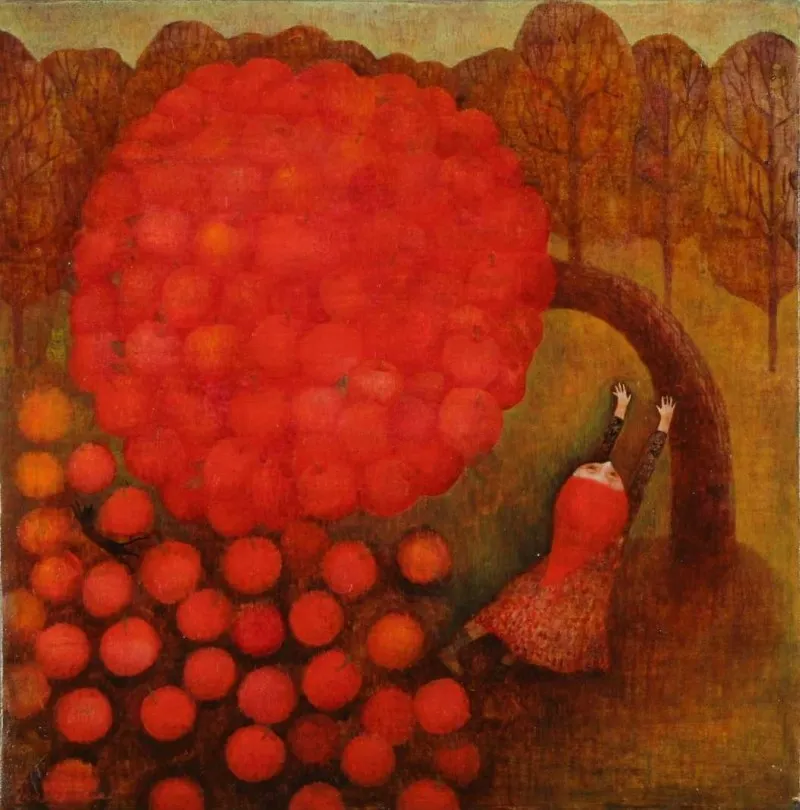
The Liberec Gallery traditionally offers visitors the opportunity to view an exhibition of children’s book illustrations during the Christmas season. This year, we present the work of Japanese illustrator Iku Dekune (born 1969), who has been living in Prague since 2002. Despite her age, Iku Dekune has already received valuable awards in the field of children’s illustration. In the graphic cabinet, original oil paintings, gouaches, watercolors, and drawings are on display, which were published in book form by publishers in Tokyo. Iku Dekune graduated in 1992 in graphics from Musashino Art University in Tokyo. Just two years later, she published her first children’s book as both illustrator and author of the text. In 1997, she received a very strong impulse through participation in a workshop for illustrators in Tokyo, led by Slovak illustrator and educator Dušan Kállay.

If her previous approach to illustrating could be expressed as “I’ll give it a try,” then after meeting Professor Kállay it changed into a deep inner conviction about the meaningfulness and mission of illustrating books for children. Already the following year, she received her first recognition in the form of participation in the International Children’s Book Fair in Bologna. A Japanese publisher offered her the opportunity to illustrate any of the 210 fairy tales by the Brothers Grimm. Iku Dekune chose the story The Guinea Pig, for which she received further recognition, the Golden Medal at the Bratislava Biennale of Illustrations in 2003. In 2002, Iku Dekune moved to Prague. The hustle and bustle of multi-million Tokyo was replaced by the genius loci of an ancient European city. This brought her calm for focused work and a wealth of creative inspiration. Her palette of colors and subjects expanded, and her artistic expression gained in persuasiveness.

Compassion for every manifestation of life
Iku Dekune’s artistic expression is entirely European

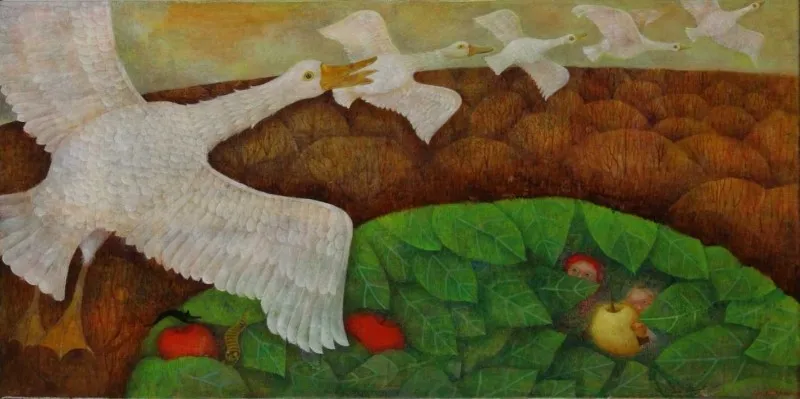
With almost every new book, Iku Dekune experimented with new artistic techniques. She gradually moved from graphic techniques to painting, starting with watercolor and culminating in the medieval technique of tempera and oil paints on a stucco surface. Using this last-mentioned technique, she illustrated the book Husy Divohusy, which was awarded the title of the most beautiful book of the year 2005 in Japan. The illustrations themselves become poetry, colors refract into many shades and acquire a silk-like shine. Delicate brushstrokes climb like tendrils of wild vine, swirling, dancing, and eventually weaving a colorful web reminiscent of the lost paradise of childhood. Iku Dekune’s artistic expression is entirely European, reflecting her cosmopolitan sensibility. When illustrating a fairy tale from a specific country, she strives to incorporate something typical of that region into the image, such as hair color, clothing, or a particular accessory.

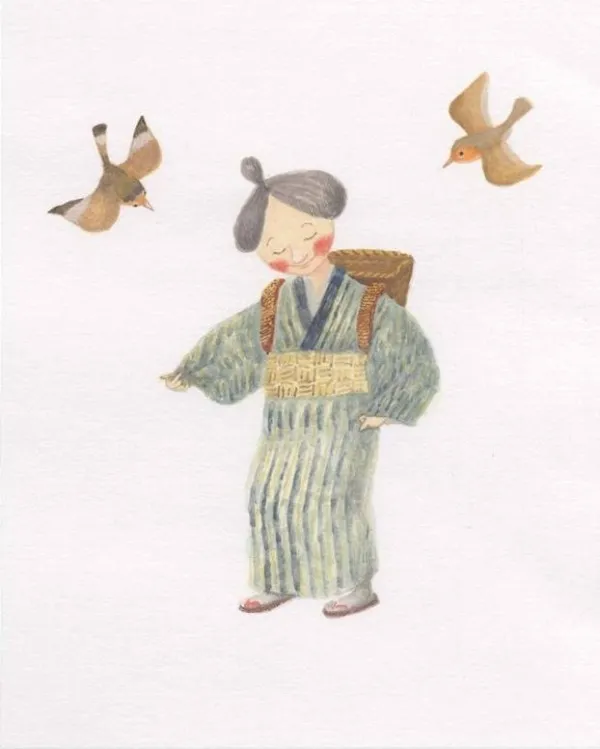
After moving to Prague, some stories by Japanese authors acquired Czech details, for example, elves celebrating a feast with typically Czech pastries. However, the latest book about Tantara, the magical grandmother from the mountains, differs in some ways from the cosmopolitan character of her previous works. It emphasizes certain principles of Japanese life and art – respect for the elderly, traditional Japanese housing and clothing, praise of shadows (the preference for scenes set in half-light), and the use of asymmetry and empty space in composition.

The word illustration in its original sense means to illuminate, to bring light. In recent years, Iku Dekune has also illustrated books with serious messages, whose texts could be aimed at adults. They are not fairy tales in the strict sense, but stories (as if) from life. And it is precisely Iku Dekune’s illustrations that brighten the parts of the story that might otherwise evoke sadness or uncertainty in a young reader. Through her images, the reader enters a world that is colorful, poetic, and highly friendly to the child’s soul. Sometimes the reader peeks into the community of hardworking and cheerful elves who help a little girl recover (Dwarfs from the World of the Quilt), other times into a story set in the tropical rainforest, revealing the hidden order of nature (Crocodile). Particularly impressive are those illustrations in which the artist can express empathy for every manifestation of life, whether human or animal.

Visit also

Věra Nováková & Pavel Brázda | Paintings, Words, Irises

Věra Nováková & Pavel Brázda | Paintings, Words, Irises

4/18/2026 – 7/12/2026

The work of two exceptional artists, life partners and companions, Pavel Brázda and Věra Nováková, reveals numerous similarities as well as strikingly contrasting tendencies. Alongside veristic painting, both artists also embraced pronounced stylisation and worked with structurally conceived paintings, often approaching the language of Informel. Their individual trajectories diverge in subject matter and in their engagement with Christianity, which each approached in a markedly different—indeed opposing—manner. Most notably, however, their differences emerge in their understanding of the relationship between the original artwork and its copy. While Věra Nováková remained committed to the unique artefact (often emphasised by her choice of subjects, such as portraits of figures close to her from the art world, as well as representatives of the Catholic faith), Pavel Brázda, inspired by his hominist ideas, leaned towards the democratisation of art. Art, in his view, should be accessible to all. For this reason, Brázda enthusiastically multiplied, reproduced, and replicated his works—first using xerography and later digital printing on canvas. As a result, some of his figures and heads exist in numerous variants, reappearing in different compositions and schemes. The first thematic line of the exhibition focuses on figures, heads, and portraits, highlighting the distinct artistic approaches of both authors.

FaVU VUT | Surfaces & Spaces

FaVU VUT | Surfaces & Spaces

4/18/2026 – 7/12/2026

The exhibition presents works by students and graduates of two studios at the Faculty of Fine Arts of Brno University of Technology – Drawing and Printmaking Studio and Spatial Design Studio. A dialogue emerges between the two groups of works, in which spatial thinking intersects with approaches that extend far beyond the level of the flat surface.

Spatial Design Studio works with forms ranging from sculptural objects through installations, kinetic and audiovisual works to site-specific interventions. A shared feature of the presented works is an emphasis on material experience, the physical presence of the artwork in space, and work with movement, sound, light, and time, as well as a sensitive relationship to the context in which the works are created and to the environments for which they are intended or in which they may appear.

Wolfwalkers | ANIFILM

Wolfwalkers | ANIFILM

4/18/2026 – 7/12/2026

For the fourth time, the Museum of Fine Arts Liberec will join forces with the International Festival of Animated Films Anifilm (5–10 May 2026) to prepare an exhibition linked to the festival’s theme. The centrepiece of the festival will be a retrospective of one of the most important contemporary animation studios, the Irish Cartoon Saloon, whose films such as The Secret of Kells, Song of the Sea and Wolfwalkers have defined European animation for almost the past twenty years. They enjoy worldwide popularity, combining bold visual approaches with strong storytelling, while naturally drawing on Irish mythology. On this occasion, Anifilm will present an exhibition of original artefacts from the film Wolfwalkers. These will include original character and environment designs, production phases from the film, and other unique materials offering insight into the making of this award-winning feature film by the director duo Tomm Moore and Ross Stewart.

Patron annual entry fee
Art is my life!

Become our patron. Support the gallery and enjoy access to VIP events, discounts in the design shop, and much more.

Visit us

Masarykova 723/14
Liberec 460 01
CZ

Opening hours

monday
tuesday
wednesday
thursday
friday
saturday
sunday
closed
10.00–18.00
10.00–18.00
10.00–19.00
10.00–19.00
10.00–18.00
10.00–18.00

Entrance fees

Standard admission
180 Kč
Reduced admission
100 Kč

Exhibition galleries are closed. The Design Shop and café remain open during regular opening hours.