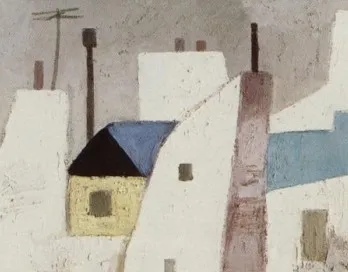
The urban environment is not hostile to her; on the contrary, it inspires her to create poetic visions of the everyday beauty of houses, streets, and corners. She is not bothered by chimneys, the strict lines of electric poles, or bridges echoing with the rumble of trains. She seeks and finds a place for them within her artistic vocabulary. Even something extremely unappealing, such as neglected, half-ruined houses covered in years of dust, transforms in her paintings into something rare and remarkable.
The works of her early period are characterized by vibrant expressive colors (Path Between Fields, 1954), sometimes coolly darkened (Winter in Turnov, Alley in Turnov, 1956). A strong contour line becomes an important expressive tool (Libeň Bridge, 1959), sometimes emphasizing geometric-constructive rhythm (Coal Warehouse, 1959).
From panoramic views of parts of the city in the 1950s, Jaroslava Solovjevová gradually moved to paintings of smaller architectural units, following the cubist tradition “in the most beautiful line, created by the classics of Czech Cubism” (František Dvořák). Works from this period are characterized by simpler compositional structures and rhythmic alternation of tightly packed forms and surfaces. The restrained color palette is enlivened by contrasts and the structural plasticity of the color mass (Paris Suburb, 1968).
Jaroslava Solovjevová’s first visit to Paris marked the discovery of a new subject – the artistic translation of views of typical rental houses with mansard roofs, studios, and bizarre chimneys, characteristic of the Parisian suburbs (Kouřovody 2, 1985; Purple House, 1985). This fascination has stayed with the painter to this day, only the form has evolved.
The 1970s, despite unfavorable social conditions, brought her new inspiration. The bright light of the South illuminated her colors and softened individual tones into delicate fragility. Solid, crystalline planes were replaced by a transparent yet still tectonic form, whose curved lines complement the austerity of the geometric structure. Transparency and lightness invite the viewer to fill the painting with their own story or experience (White Street, 1976; White Paris, 1980; Dubrovnik, 1984). Finding parallels to the first period is not difficult. The civilist tradition, close to the aforementioned works, can be found, for example, in František Hudeček; the combination of dark contour lines with vivid color in Karel Černý; or among the Expressionists, for instance in early Kandinsky. Finding parallels to the later periods is much more difficult. The paintings of lyrical moods in Jaroslava Solovjevová’s urban landscapes are original in their balance of reality and dream, the seen and the felt, seeking harmony between the architecture of the city and the soul of its inhabitant.
The aim of the exhibition is to convey to the general public the painter’s fascination with the poetry of everyday life and to give experts the opportunity to situate Jaroslava Solovjevová’s work within a distinctive and important artistic current that develops the tradition of Czech Cubism.