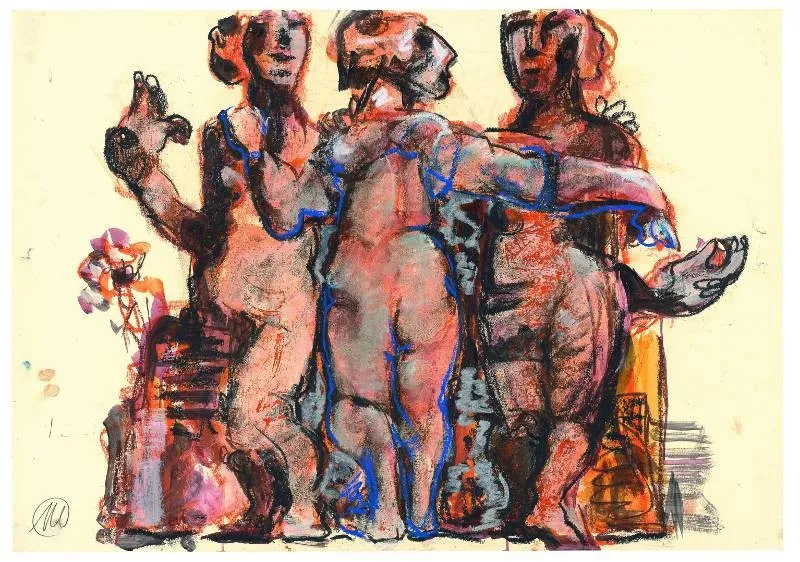
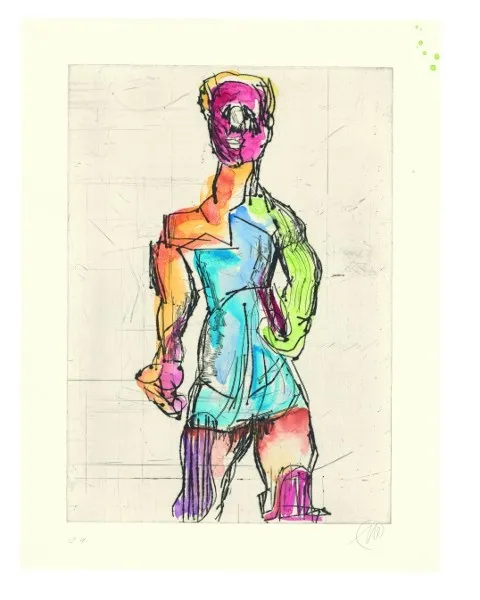
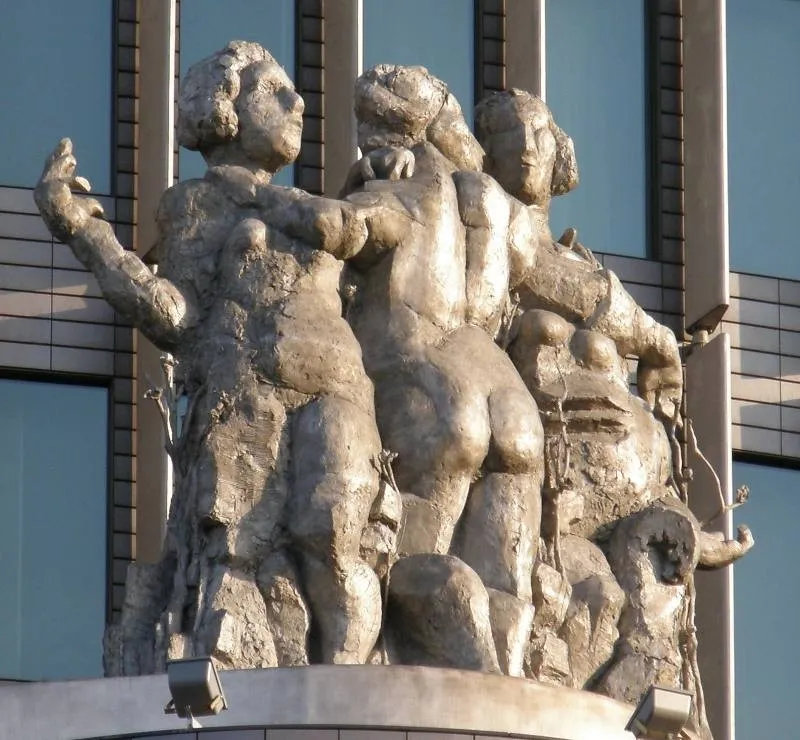
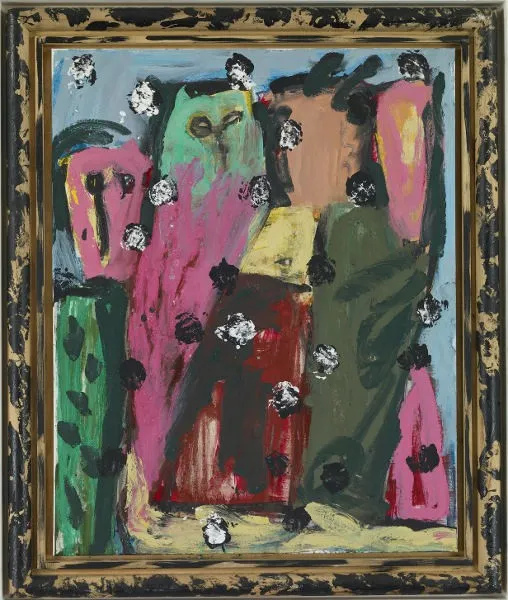
In the 1980s, Lüpertz began experimenting with volume and created his first sculptures. Both in painting and sculpture, he repeatedly returns to the human figure, though heavily influenced by many sources: classical Greece, African art, Cubism, and Surrealism. In the 1980s, Lüpertz himself "discovered" the French painter Jean-Baptiste Camille Corot (1796–1875), the most famous representative of the Barbizon school (the Regional Gallery manages one of the largest collections of Barbizon school works in the Czech Republic!) and the classical painter Nicolas Poussin (1594–1665), acknowledging their influence on his work. Besides painting, sculpture, and poetry, from the early 1980s he occasionally engaged in scenography as well.
Markus Lüpertz received numerous awards for his artistic work (German Critics' Prize, 1970; Villa Romana scholarship, 1970; Lovis Corinth Prize, 1990) and also achieved success as an educator. Besides his work in Karlsruhe, he was appointed professor at the State Academy of Fine Arts in Düsseldorf in 1986, where he served as director and teacher from 1988 to 2009. (Among others, Czech artist Lubomír Typlt, whose works we present alongside Lüpertz's exhibition, studied in Markus Lüpertz's studio.)
Markus Lüpertz’s works have been exhibited in solo and group exhibitions over the last four decades in Germany, the Netherlands, Italy, France, Spain, Great Britain, Austria, Switzerland, Luxembourg, Finland, Belgium, Slovenia, and the USA. They are represented in the collections of many prominent world museums and adorn public spaces in several European cities.
His work reflects a mixture of dialogue between the past, Greek myths, religious sentiment, and a love of poetry and literature. Like the works of Georg Baselitz, Jörg Immendorff, and Anselm Kiefer, his art is most often classified as German Neo-Expressionism.
Markus Lüpertz has not yet exhibited in the Czech Republic (except for the sculpture Paris sans bras, 2004, bronze, 355 x 77 x 67 cm, at Sculptor Forum Winter Liberec, 2008–2009), making the Liberec exhibition exceptional in this regard. The exhibition at the Regional Gallery also has another symbolic dimension. The leading German artist Markus Lüpertz is being presented for the first time in his hometown and in the year of his important life jubilee, as he turns 70.
The Liberec exhibition includes works created in the last two decades of the artist’s career. The selection of works and the entire preparation of the exhibition were carried out in cooperation with Kunstforum Ostdeutsche Galerie Regensburg.
1941
Born in Liberec
1948
Family fled from Liberec to West Germany and settled in Rheydt in the Rhineland
1956–1961
Studies at the School of Arts and Crafts in Krefeld under Laurens Goosens
Stay in the Maria Laach monastery by Lake Laach in the Rhineland
Spent one year working in coal mines
Further studies in Krefeld and at the Academy of Arts in Düsseldorf
Works on road repairs
Repeated stays in Paris
Since 1961
Active as a freelance artist
1962
Moves to Berlin
Begins working on so-called dithyrambic painting
1963
Starts working on the Donald Duck series
1964
Opening of Gallery Großgörschen 35 in Berlin with an exhibition of dithyrambic painting
1966
Publishes the manifesto Kunst, die im Wege steht. Dithyrambisches Manifest (Art that stands in the way. Dithyrambic Manifesto)
1968
Publishes the manifesto Die Anmut des 20. Jahrhunderts wird durch die von mir erfundene Dithyrambe sichtbar gemacht (The grace of the 20th century is made visible by the dithyramb I invented)
First exhibition at Michael Werner Gallery in Berlin (since then regularly exhibits at Michael Werner Galleries in Cologne and New York)
1970
Wins Villa Romana prize, enabling a one-year stay in Florence
Begins working on Deutsche Motive (German Motifs)
Wins the German Critics Association Award
1973
Solo exhibition at Staatliche Kunsthalle in Baden-Baden
1974
Organizes the 1st Berlin Biennale
Visiting lecturer and from 1976 to 1987 full professor at the State Academy of Fine Arts in Karlsruhe
1975
Publishes first poetry booklet 9 x 9
1977
First Stil-Bilder (Style Pictures)
Exhibition of Dithyrambic and Stil-Bilder at Kunsthalle Bern
Murals for the Ruhleben crematorium in Berlin
Together with Georg Baselitz, declines participation in documenta 6 in Kassel
1980
Begins working on the Alice in Wonderland cycle
1981
Publishes poetry collection und ich spiele, ich spiele … (and I play, I play …)
1982
Participates in documenta 7 in Kassel; designs the set for Vincent Rainer Kunad’s opera at the State Theater Kassel
Publishes poetry book Ich stand vor der Mauer aus Glas (I stood before the glass wall)
1983
Creates set design for Jules Massenet’s opera Werther at the Ulm theater (removed before premiere at actors’ request)
Professor at the Summer Academy in Salzburg
Publishes Gedichte 1961–1983, Auswahl (Poems 1961–1983, Selection)
Exhibition at Stedelijk Van Abbemuseum in Eindhoven
1984
Extended stay in New York
Publishes Tagebuch New York 1984 (New York Diary 1984) and Bleiben Sie sitzen Heinrich Heine (Stay seated, Heinrich Heine)
Begins working on Pierrot Lunaire paintings
1985
First painting inspired by Jean-Baptiste Camille Corot (1796–1875), the most famous representative of the Barbizon school
Begins exploring ancient themes
1986
Professor at the State Academy of Fine Arts in Düsseldorf; rector of the Academy from 1988 to 2009
Begins working on Zwischenraumgespenster (Interspace Ghosts) series
Exhibition Belebte Formen und kalte Malerei. Gemälde und Skulpturen (Animated Forms and Cool Painting. Paintings and Sculptures) at Lenbachhaus State Gallery in Munich
Publishes book about J.-B. C. Corot: Hommage à Prévost, Berthe Morisot und Trouillebert (Tribute to Prévost, Berthe Morisot, and Trouillebert)
Sculpture Titan
1989
Retrospective exhibition of paintings, sculptures and drawings from 1964–1988 at Abbaye Saint-André, Centre d'Art Contemporain in Meymac, France
First painting inspired by Nicolas Poussin
1989/90
Design and realization of church windows for the cathedral in Nevers, central France
1990
Wins Lovis Corinth Prize
1991
Designs set and costumes for the opera Der Sturm (The Tempest) by Frank Martin (based on William Shakespeare) for the theater in Bremen
Retrospective exhibition at Museo Nacional Centro de Arte Reina Sofía, Madrid, showing works from 1963–1990
1993
Comprehensive exhibition of paintings, sculptures and drawings at Kunstmuseum Bonn
Begins working on Männer ohne Frauen. Parsifal (Men Without Women. Parsifal) series
1994
Exhibition at Palais Liechtenstein in Vienna
Exhibition on the theme of war at Reuchlinhaus in Pforzheim
1995
Pforzheim exhibition reprised at Stuttgart City Gallery
Exhibition of bronze sculptures travels to Kunsthalle Mannheim, Städtische Kunstsammlungen Augsburg, and Gerhard Marcks Haus in Bremen
Exhibition Der mediterrane Mythos (The Mediterranean Myth) at the Museum of Modern Art in Bolzano
Sculpture Judith
1996
Thematic retrospective exhibition at Kunstsammlungen Nordrhein-Westfalen, Düsseldorf, accompanied by a symposium
Begins the Othello cycle
Designs set and costumes for Verdi’s Il Trovatore for the German Opera on the Rhine in Düsseldorf and Duisburg
1997
Extensive exhibition at Stedelijk Museum Amsterdam
Exhibitions at Kunsthalle Hypo-Kulturstiftung Munich and Museum Von der Heydt in Wuppertal
Begins working on a new series with landscape motifs
1998
Exhibition of sculptures at Bill Lowe Gallery, Atlanta
First showing of paintings from the Monte Santo series at Michael Werner Gallery, Cologne
1999
Completes the Vanitas cycle and exhibits it in the former coking plant Zeche Zollverein in Essen
2000
Exhibits a set of three sculptures at Bensberg Castle grounds in Bergisch Gladbach
First presentation of the Vespers cycle as part of the exhibition Lost Paradise Lost. Kunst und sakraler Raum (Lost Paradise Lost. Art and Sacred Space) in Hanover
2001
Commissioned to redesign the entrance area in front of the Federal Chancellor’s Office in Berlin
Murals Die sechs Tugenden (The Six Virtues) complement the bronze sculpture Die Philosophin (The Philosopher) in the foyer
2002
Exhibition at Institut Valencià d'Art Modern in Valencia—in the Julia González Center and at the Würth Museum in Künzelsau
2004
Awarded the IV International Julia González Prize (March 27, 2004)
2005
Unveiling of the sculpture Adler (Eagle) at the Federal Court building in Karlsruhe and Hommage an Mozart (Homage to Mozart) in Salzburg
2006
Honorary doctorate from the Academy of Arts in Wrocław (October 25, 2006)
2007
Unveiling of the sculpture Mercurius (Mercury) in front of the Post Tower in Bonn (headquarters of Deutsche Post DHL)
2008
Unveiling of stained glass designed for St. Andrew’s Church in Cologne
2009
Unveiling of the sculpture Apollo in front of Elizabeth Church in Bamberg
Steps down as director of the State Academy of Fine Arts in Düsseldorf
2010
Exhibition Metamorphosen der Weltgeschichte (Metamorphoses of World History) at Albertina in Vienna
Selected Collections:
- Kunstmuseum Walter, Augsburg
- Kunsthalle, Baden-Baden
- National Gallery, Berlin
- Kunsthalle, Bern
- Palais des Beaux-Arts, Brussels
- Kunsthalle, Düsseldorf
- Stedelijk Van Abbemuseum, Eindhoven
- Haus der Kunst, Munich
- State Museum, Munich
- Pinakothek der Moderne, Munich
- Musée d'Art Moderne de la Ville de Paris, Paris
- Musée d'Art et d'Industrie, Saint-Étienne
- Art Museum, Saint Louis
- Moderna Museet, Stockholm
- Musée d'Art Moderne et Contemporain, Strasbourg
- Museum Tel Aviv
- Musée d'Art et d'Histoire, Geneva
Selected Exhibitions:
- "Markus Lüpertz - Dithyrambic Painting", Galerie Großgörschen 35, Berlin, 1964
- "Markus Lüpertz - Art That Gets in the Way", Galerie Großgörschen 35, Berlin, 1965
- Galerie Michael Werner, Berlin, 1968
- Staatliche Kunsthalle, Baden-Baden, 1973
- Hamburger Kunsthalle, Hamburg, 1977
- Kunsthalle, Bern, 1977
- Stedelijk Van Abbe Museum, Eindhoven, 1977
- Whitechapel Art Gallery, London, 1979
- Marian Goodman Gallery, New York, 1981 and 1982
- Musée d'Art Moderne et Contemporain, Strasbourg, 1983
- "Markus Lüpertz - Stay Seated Heinrich Heine", Wiener Secession, Association of Visual Artists, Vienna, 1984
- "Markus Lüpertz - Animated Forms and Cold Painting", Städtische Galerie im Lenbachhaus, Munich, 1986
- Waddington Galleries, London, 1986
- Kunsthalle zu Kiel; Schleswig-Holsteinischer Kunstverein, Kiel, 1988
- Rena Bransten Gallery, San Francisco, 1988
- Centre d'Art Contemporain, Abbaye Saint-André, Meymac, 1989
- Coastal Gallery Piran, Ljubljana, 1989
- Galleria In Arco, Turin, 1989
- "Markus Lüpertz - Retrospective 1963-1990 - Painting, Sculpture, Drawing", Museo Nacional Centro de Arte Reina Sofía, Madrid, 1991
- Cleto Polcina Artemoderna, Rome, 1991
- Galerie Beaumont, Luxembourg, 1991
- Kunstmuseum Bonn, 1993
- "Markus Lüpertz - Paintings After Poussin", Museum Ostdeutsche Galerie, Regensburg, 1993
- Museion - Museum of Modern and Contemporary Art, Bolzano, 1995
- Galerie Montenay, Paris, 1995
- Kunstsammlung Nordrhein-Westfalen, Düsseldorf, 1996
- Locks Gallery, Philadelphia, Pennsylvania, 1996
- Staatliche Antikensammlung und Glyptothek, Munich, 1996
- Kunsthalle der Hypo-Kulturstiftung, Munich, 1997
- "Markus Lüpertz - The Three Graces", Galerie Michael Werner, Cologne, 2004
- "Markus Lüpertz, Durs Grünbein - Daphne - Metamorphosis of a Figure", Sinclair-Haus der Altana AG, Bad Homburg, 2005
- "Markus Lüpertz - Pictures, Sculptures, Works on Paper 1989-2006", Galerie Noah im Glaspalast, Augsburg, 2006
- Galerie de France, Paris, 2007
- "Markus Lüpertz - Tents - Early Dithyrambs", Galerie Michael Werner, Cologne, 2007
- "Markus Lüpertz - Dithyrambic Painting 1967-1971", EL SOURDOG HEX, Berlin, 2009
- "Markus Lüpertz - Main and Side Roads - Retrospective", Kunst- und Ausstellungshalle der Bundesrepublik Deutschland, Bonn, 2009
- "Markus Lüpertz - Chemnitz Mélange - An Insight", Kunstsammlungen Chemnitz, 2009
- "Markus Lüpertz - METAMORPHOSES OF WORLD HISTORY", Albertina, Vienna, 2010
The exhibition at the Regional Gallery in Liberec was financially supported by the Ministry of Culture of the Czech Republic and the Czech-German Future Fund. Thank you!