Itinerant Marionette Theatre
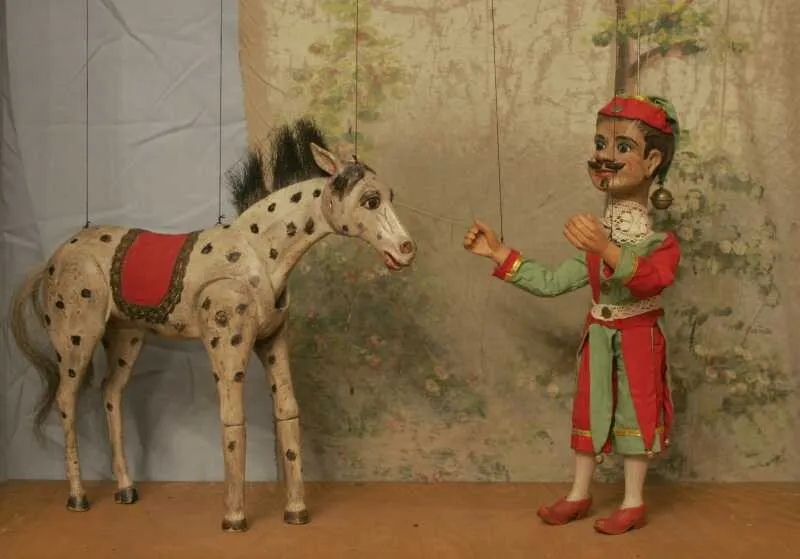
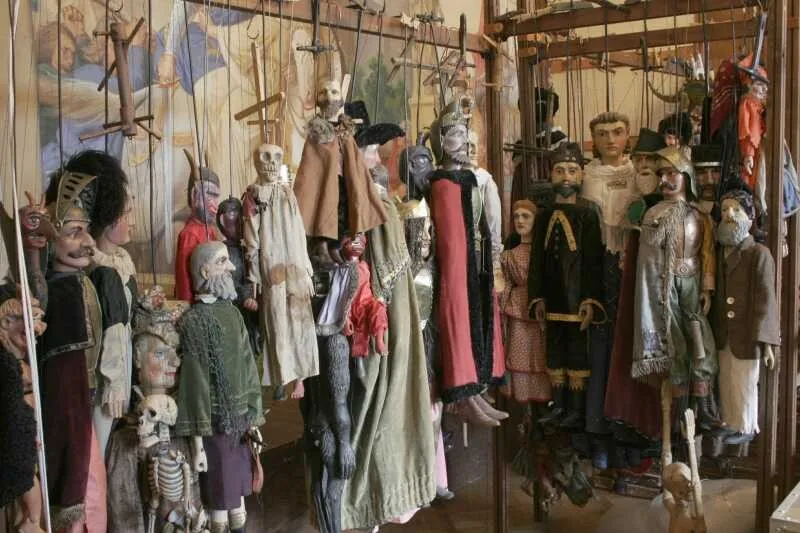
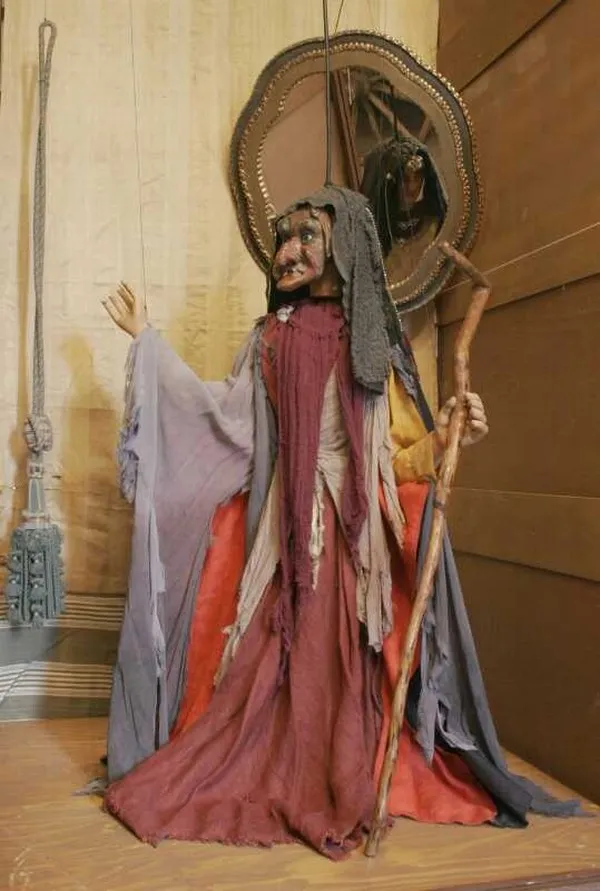
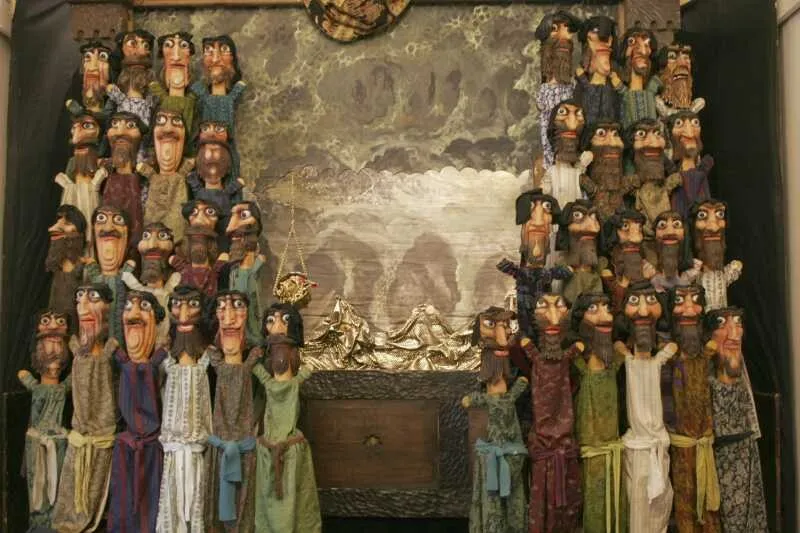
This section presents the historical form of marionette theatre performed by Czech itinerant puppeteers. It covers approximately 200 years of history, the artistic style, and technology of the most commonly used puppets, decorations, and stage setups of the time. It also explores the social status, connections, and function of this theatre form. The exhibition features selected unique works from traditional carving workshops and master carvers from the 19th and early 20th centuries. Visitors learn about types of puppets (marionettes, mikrlata, hand puppets, variety puppets), character typologies, and the carving styles of the best-known creators who made puppets for famous puppeteer families. Among the most valuable carvings are puppets from the workshop of Mikoláš Sychrovský (1802–1881) from Mirotice in South Bohemia, two generations of the Sucharda carvers (Antonín the Elder 1812–1886, Antonín the Younger 1843–1911) from Nová Paka, and the permanently Prague-based Italian Josef Allesi (c. 1820–1895). Arranged scenes from specific plays and brief excerpts illustrate the characteristic repertoire of marionette theatre.
Family and Amateur Puppetry
The term "family puppetry" refers to a part of Czech amateur puppetry in the first half of the 20th century, representing a large movement among the general public. It highlights the popularity and widespread use of professionally and amateur-made table puppetry and puppets in households. This section introduces the remarkable production of several Czech puppetry companies that made puppets and decorations for family and amateur theatres. Selected exhibits emphasize the special contribution of many outstanding Czech artists to this field. Included are collections of modeled puppets and some of their prototypes, from the unique first Czech puppets of this type from 1912 known as “Alšovky” (inspired by Mikoláš Aleš’s illustrations), to puppets from firms such as Münzberg, Modrý & Žanda, for which well-known visual artists and sculptors modeled the originals, to unique, original puppets created by artists for specific family theatres. Also on display are unique lithographs of the first Czech printed “Decorations by Czech Artists” published since 1913, including the first outstanding proscenium by František Kysela, as well as all major printed theatre collections of the interwar period (e.g., by Karel Štapfer, Miroslav Kolář). The accompanying materials recall the usual practices of companies, the atmosphere of the time encouraged by the educational efforts of puppetry historian Jindřich Veselý and the Czech Association of Friends of Puppet Theatre, the repertoire, and the significance of the family puppetry phenomenon.
Classical Czech Modernism and Amateur Puppetry
This part of the exhibition presents Czech classical modernist puppetry through examples from several important amateur theatre groups of the time (Puppet Theatre of Holiday Colonies in Plzeň, Artistic Puppet Stage, Puppet Theatre of Artistic Education, and the Artistic Stage “Realm of Puppets” in Prague). The exhibits demonstrate the transformation of puppet aesthetics in the first half of the 20th century influenced by new art movements (Art Nouveau, Cubism, Cubo-Expressionism, Functionalism, Expressionism), documenting the artists’ efforts influenced by Czech theatrical avant-garde to create new types of puppets and stage designs emphasizing “pure” stylistic expression (including unusual techniques, especially Asian ones, and the use of diverse materials). The accompanying materials also highlight the reform repertoire with richer and more valuable themes and several important puppetry personalities (Skupa, Malík, Sucharda).
Modern (Institutional) Puppet Theatre
This section outlines the transformation of Czech puppet theatre linked with its professionalization and institutionalization, which meant artistic recognition. It also presents the contemporary work of professional puppet theatres. Exhibits include puppets and sometimes also stage designs created by professional puppetry scenographers for specific performances. A few exhibits also recall contemporary free artistic creation inspired by puppetry and puppet theatre. Accompanying documents briefly mention important puppetry festivals in the Czech Republic.
Organizers:
Festival “Titirijai 07,” Tolosa (Spain)
Czech UNIMA Centre
Association of Professional Puppeteers
Festival “Mateřinka,” Naivní Divadlo Liberec
Moravian Museum, Brno
Regional Gallery in Liberec
Concept, Script, and Production: Jaroslav Blecha
Design: Antonín Maloň, Miroslav Foretník
Realization: Eva Herzanová, Helena Šedá, Antonín Maloň, Igor Schmidt, Jaroslav Blecha
Lenders of Exhibits:
Moravian Museum, Department of Theatre History (Brno)
Museum of Puppetry Cultures (Chrudim)
National Museum, Theatre Department (Prague)
Cheb Museum (Cheb)
Municipal Cultural Centre (Letovice)
Silesian Museum (Opava)
Divadlo DRAK (Hradec Králové)
Naivní Divadlo Liberec (Liberec)
Divadlo Alfa (Plzeň)
Divadlo Lampion (Kladno)
Divadlo Minor (Prague)
Spejbl and Hurvínek Theatre (Prague)
Loutkové Divadlo Radost (Brno)
Divadlo Rozmanitostí (Most)
Artistic Stage “Realm of Puppets” (Prague)
Funding:
Ministry of Culture of the Czech Republic
Ministry of Culture of Spain
Ministry of Culture of the Basque Country
Guipúzcoa Provincial Government
City Hall of Tolosa