Accompanying Programs and Guided Tours at the Regional Gallery in Liberec
Currently, the professional association called the Czech Galleries Council consists of a total of 28 collecting galleries and art museums, including the National Gallery in Prague and the Moravian Gallery in Brno. The Galleries Council, founded on January 2, 1992, initially as the Council of State Galleries of the Czech Republic, has organized not only numerous professional meetings, lectures, and seminars but also several joint exhibitions. At the turn of 1993/1994, it held the exhibition “Record of the Most Diverse Factors” (Czech Painting of the Second Half of the 20th Century from State Gallery Collections), and five years later, in 1998, the exhibition “Acquisition Activities of Galleries in 1990–1997.” Both of these exhibitions took place in the Riding Hall of Prague Castle, the first under the patronage of then-Prime Minister Václav Klaus, and the second under the patronage of the acting Minister of Culture Pavel Dostál.
This professional association also tried organizing an exhibition abroad. In 2001, the exhibition “Surrealism in Czech Art 1925–1945” took place at the Panorama Museum in Bad Frankenhausen, Germany. Since the member galleries and museums are distributed across the country, it was decided that the next joint exhibition project would be held outside Prague in an institution with sufficiently large exhibition space. In the autumn of 2004, the exhibition “Drawing, Drawing… (Czech Drawing of the 1980s)” was organized at the Meat Market – the exhibition space of the West Bohemian Gallery in Pilsen, under the patronage of the Governor of the Pilsen Region, Dr. Petr Zimmermann.
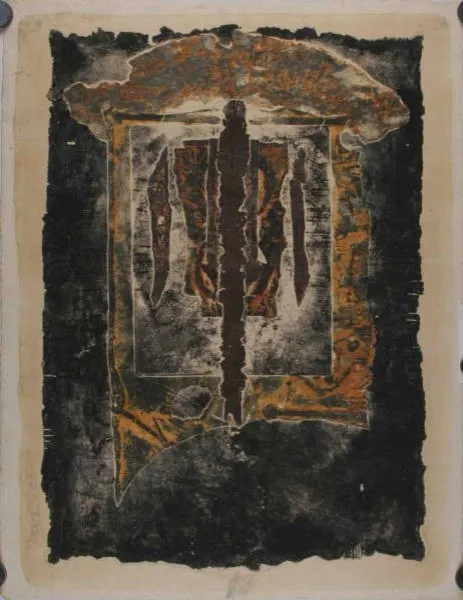
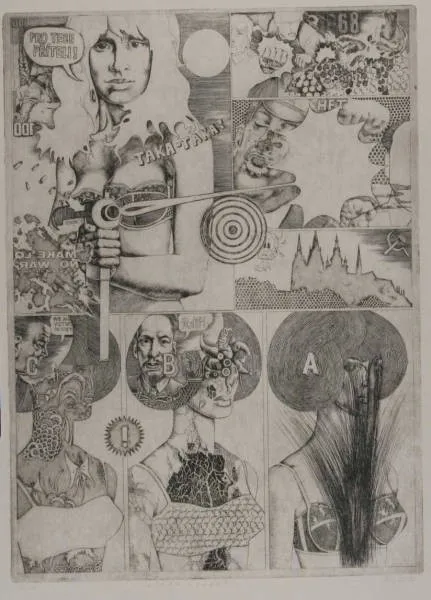
Now, at the time of the 15th anniversary of the Czech Galleries Council, the curatorial team, in cooperation with all member galleries, has prepared the exhibition “Focused View” (Graphics of the 1960s) to present the richness, scope, and importance of graphic collections, especially of institutions located in the regions. Works on paper, due to lighting requirements and the fragility of the paper, are stored in depositories and cannot be exhibited for extended periods.
They are therefore little known. Although it may seem that studying graphic collections in today’s era of progressive use of digital technologies in the artistic sphere—as well as in the context of the boom of various forms of conceptual expressions and installations—is too classical an approach, the justification for this choice lies in the very subject of the scholarly study. The aim of the project is to acquaint both the professional public and the widest possible spectrum of visitors with an artistic field that, in the 1960s, reached its peak in depicting the diversity of modern human existence amid revolutionary and unique social events, while also enabling an unprecedented exploration of spiritual and psychological states of the human inner world and capturing the relationships of modern perception of nature and the world.
Graphic art of the 1960s, like Czech art in general at that time, was charged with new experiments. All of this extraordinarily enriched the expressive and technical repertoire of traditional graphic techniques with a range of new procedures and materials. They have not lost their relevance even today, considering that graphic art in the territories of Bohemia, Moravia, and Slovakia developed essentially from the turn of the 19th and 20th centuries initially as a private hobby of artists, and only from 1910 as a university-level academic discipline.
In the 1960s, graphic art reached an unprecedented flourishing thanks to distinguished artists—classics of the graphic craft—such as Jiří John and Ladislav Čepelák, as well as creators from the circles of groups like UB 12 (Alena Kučerová, Adriena Šimotová, Oldřich Smutný, Jiří John…), Trasa (Jitka and Květa Válovy), the Confrontations exhibitions (Jan Koblasa, Aleš Veselý, Čestmír Janošek, Pavel Nešleha), New Sensitivity (Zdeněk Sýkora, Karel Malich…), and later the Club of Concretists, as well as individual artists, including not only Vladimír Boudník but also Jiří Anderle, Bohuslav Reynek, and many others.
This exhibition takes into account the developments in the Prague art scene during the emergence of various artistic tendencies – from Informel through New Figuration to geometric directions. It also highlights the contributions of artists from other regions – for example, the Loun artists Zdeněk Sýkora and Miroslav Mirvald, as well as Bohuslav Reynek from Petrkov, a creator of profound spiritual depth, the Ostrava experimenter Eduard Ovčáček, and the lyrical Cubist Jánuš Kubíček from Brno.
To a lesser extent, the exhibition presents graphic works by newly discovered regional personalities, such as Anna Poustová, Vladimír Rocman, Miloslav Cicvárek, and Dobroslav Foll. In connection with the state coexistence of the Czech Republic and Slovakia, some Czech galleries also included Slovak artists – graphic artists – in their acquisition programs; therefore, works by Vincent Hložník, Albín Brunovský, and others became a justified part of the exhibition.
In the international “Sixties” context, which could only be fully theoretically clarified in Czech art history during the 1990s, the contribution and significance of the pioneers of 1960s graphic art were fully revealed, especially Vladimír Boudník, Zdeněk Sýkora, and Radoslav Kratina. A completely unique and exceptional place in gallery acquisition programs was also occupied by world graphics.
An extensive collection is managed by the Loun Art Museum – Benedikt Rejt Gallery. Several graphic sheets of European provenance are also exhibited from the collections of the Museum of Art in Olomouc. Several exhibitions have been devoted to the development of graphics in former Czechoslovakia. The 1960s, from the perspective of their own collections, were addressed only by a National Gallery project in 1994 and also by the Karlovy Vary Art Gallery in 1996. The graphic collections of member galleries are very extensive. Many works, due to the number of printed graphics, appear in the collections of several different galleries. The preparatory committee faced the task of addressing this issue. Its “most painful task” was, however, to reduce the selected set to an exhibition collection of 160 graphic works, which could realistically be displayed. It includes works by 95 graphic artists.
Although each member gallery is represented at the exhibition by at least one work, the decisive criteria were the quality of the work and the contribution of its author to graphic thinking. This was not easy, given the extensive graphic collections held by the member galleries. Unlike the often missing paintings or sculptures from the 1960s, this time no “empty space” was created, and significant representatives of 1960s graphic art are abundantly represented in regional galleries.
With few exceptions, in almost every collection one can find aquatints by Ladislav Čepelák, drypoints by Jiří John, etchings and perforated prints by Alena Kučerová, graphics by Naděžda Plíšková, and others. Works by Adriena Šimotová, Jaroslav Šerých, Pavel Sukdolák, Miloš Ševčík, and Jan Koblasa are also included. A remarkable situation is that in almost every gallery fund, original structural and active graphics by the prematurely deceased Vladimír Boudník are represented. His contemporary Jiří Balcar, a promoter of the New Figuration, whose life was also short, received considerable attention. The graphic work of Jiří Anderle is also extensively documented.
The events in 1960s graphics are very originally complemented by the “Moravian” masters – Dalibor and Ivan Chatrný, Jaroslav Hovadík, Jánuš Kubíček, Eduard Ovčáček, and Pavel Navrátil – whose collections are also numerous. Significant graphic series from the 1960s, exceeding several hundred sheets, are held by Prague collections (National Gallery, Gallery of the Capital City of Prague, and the Czech Museum of Fine Arts), the Moravian Gallery in Brno, the Gallery of Fine Arts in Ostrava, the Museum of Art in Olomouc, the Regional Gallery in Liberec, the North Bohemian Gallery of Fine Arts in Litoměřice, the Gallery of Modern Art in Hradec Králové, and the Karlovy Vary Art Gallery. The previously mentioned graphic collection of the Benedikt Rejt Gallery in Louny has already acquired a substantial and distinct Czech and international profile.
A catalogue with color reproductions and English translation, graphically designed by Jiří Mědílek, has been published for the exhibition.
Božena Vachudová