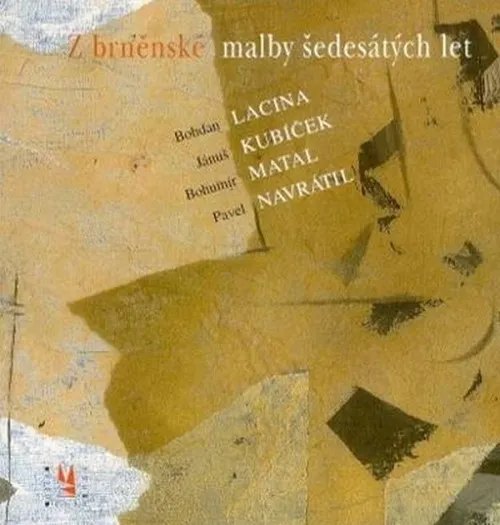
The oldest of the artists exhibited – Bohdan Lacina (1912–1971) – linked his life with the Moravian capital, where, during the war and as a future member of the Ra Group, he began to develop his very specific, melancholy-tinged work, rooted in the Surrealism of the 1930s. Lacina gradually moved towards his own specific artistic language, characterised by metamorphoses of landscapes, birds, trees, people or flowers. The painter transforms these poetic motifs into ballad-like images in which the fantastic blends with the real, suggestion with the concrete, and soft painting with strong linear drawing. At the end of the 1940s Bohdan Lacina ceased painting for a time. Ten years of harsh communist ideology also halted his creative development, and he only returned to painting in 1958. His work of the 1960s, which loosely follows on from the early period, reaches new levels of quality in the final decade of his life. Bohdan Lacina represents a solitary figure in Czech post-war art. His highly personal style, combined with a meditative approach in which a reverence for classical painting is mixed with a quest for profound messages, stands somewhat aside from the mainstream trends of Czech art in the 1960s – which only reinforces the relevance and significance of his oeuvre today.
The second protagonist of our exhibition, Jánuš Kubíček (1921–1993), is also a painter strongly connected with Brno. The son of the sculptor Josef Kubíček, he grew up among the artistic elite of interwar Brno. In symbiosis with the work of Bohumír Matal (both were members of the Brno 57 group), he stylizes the female figure, progressing from a cubist-inspired form toward abstraction. In the series Movement in Water (1963), he abstracts the curves of the female body into entirely non-objective compositions, which, in intense shades of blue and green, represent the painter’s characteristic palette. Kubíček was also a great connoisseur of painting techniques. He continued the tradition of Antonín Procházka in encaustic painting in Moravia, experimented with tempera techniques using various binders on monumental canvases, and revived the medieval painting techniques of the van Eyck brothers. The painter never ceased to conceive the picture surface as an autonomous composition of shapes and colors, and the peak of his work can be seen in the Studios series, where in the early 1970s he achieved a highly personal illusionism within abstraction. The work of Bohumír Matal (1922–1988) also followed a distinct trajectory. In 1945, when the young painter returned from forced labor in Lohbrück, his work attracted attention in the Brno art scene in the context of the Prague Group 42. His style, moving toward a cubist figurative expression, underwent a qualitative transformation in 1962. Matal unexpectedly shifted to a kind of informal intermezzo, which ended in 1965 with a creative crisis. He never returned to informalism, and by the late 1960s, he was producing the first paintings of his new monumental series The Presence of Man.
In purely constructivist and predominantly geometrically conceived compositions with vertical lines, he applied his experience as a colorist painter in a dense palette. In the harmonious balance of this new approach, the painter reached the peak of his work. Another significant painter active in Brno in the 1960s was Pavel Navrátil (1933–1981). He was the youngest of the four representatives of our exhibition, and his artistic development had a distinct character. Pavel Navrátil entered the Brno art scene in the second half of the 1950s, initially expressing his creative vision through dynamically conceived still lifes with strongly defined contours. A turning point in his work came with a stay in Warsaw in 1960, from which he returned fully absorbed in structural painting, inspired by the walls of war-damaged Warsaw. His cycle Warsaw Walls (1960–1963) connects to contemporary European abstract art (informel, tachism, structuralism) and later evolves toward the treatment of the painting as a composition of structural planes in muted colors (Snowy Roof, Landscape, both 1963). He achieved almost velvet-like haptic effects in his painting. Navrátil’s work gained a somewhat more dynamic character after his return from Pompeii in 1969. Emotionally and visually affected by the visit to the city beneath Vesuvius, he painted a cycle of works in which he further developed his structural painting. From the brief characteristics of the work of four important representatives of Brno painting in the 1960s, several facts emerge. When we today revisit retrospectives of the 1960s Brno artists, we are interested in the common characteristic features of our art scene. While in the past these artists were automatically included in nationwide exhibitions of contemporary art, they are now often forgotten.
If we look at the work of Brno artists of the period in the context of European and Prague art, we must acknowledge that Brno responded to new impulses in art only gradually. In 1963, at the exhibition Confrontation of Brno Creative Groups, most of the exhibiting artists approached the painting as an abstraction and geometrization of what was seen. Nevertheless, it can be stated that the works of Bohdan Lacina, Jánuš Kubíček, Bohumír Matal, and Pavel Navrátil brought new qualities, enriching not only the local culture but also the broader character of the Central European region. The 1960s in Brno have a specific character in visual art. Just as the 1920s and 1930s did not bring particularly striking innovations, so the post-war art scene in the city on the Svratka River responded somewhat slowly to the rapid changes brought by the development of art in the second half of the 20th century. It seems as if Brno artists paid too much respect to the ties binding them to the past—to the tradition of classical painting and to sensory reality. This tendency is evident both in the older generation artist Bohdan Lacina and later in the works of Jánuš Kubíček and Bohumír Matal. The work of Pavel Navrátil, although among the four painters’ profiles closest to contemporary trends, also leans through its delicate "beauty" of painting and aesthetic expression toward the classical ideal. Is the desire for "beauty" and the classical ideal one of the fundamental traits of Brno painting? The confrontation of four significant painterly personalities perhaps invites reflection on this question.