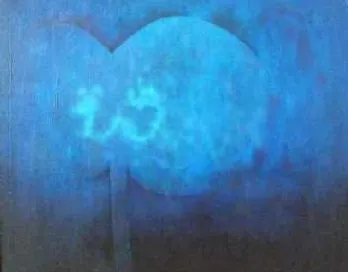
In the second half of the 1970s, he turned to a more classically colored landscape, where blue remained only in the sky and the reflections of ponds. Some of Janáček’s paintings from this period recall the atmosphere of Josef Šíma’s landscapes, yet they do not share their philosophical gravity. Rather, they are a bucolic celebration of what is seen, rather than an attempt at a metaphysical vision of the landscape—more emblematic than symbolic—appearing as natural still lifes composed of elementary organic and geometric forms. Janáček’s paintings of the 1980s and 1990s increasingly sought structural composition, emblematic quality, and formal distinctiveness within the pictorial space. After 2000, this distinctiveness culminated in geometric abstraction, in which the strictness of the lines is balanced by vivid colors. These modestly sized works create a remarkable collection, complementing the contemporary Czech scene of geometric abstract painting.
In the second half of the 1990s, as a mature artist, he began to devote himself systematically to the pastel technique. These poetic, sometimes almost musical compositions capture a vision of the world where its individual components live in harmony. Thematically, they are lyrical and urban landscapes in which vegetation permeates the surrounding environment. In them, one can find the artist’s admiring relationship with the Czech landscape, but also his deep affection for the centuries-old traditional culture of France. Janáček’s pastels are visions of a joyful world, embodied in delicate, velvety shimmering color tones.
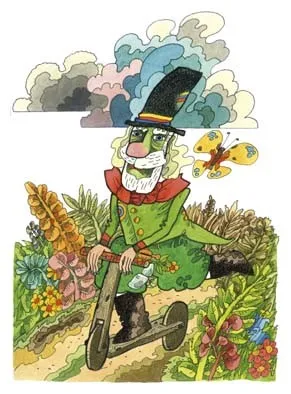
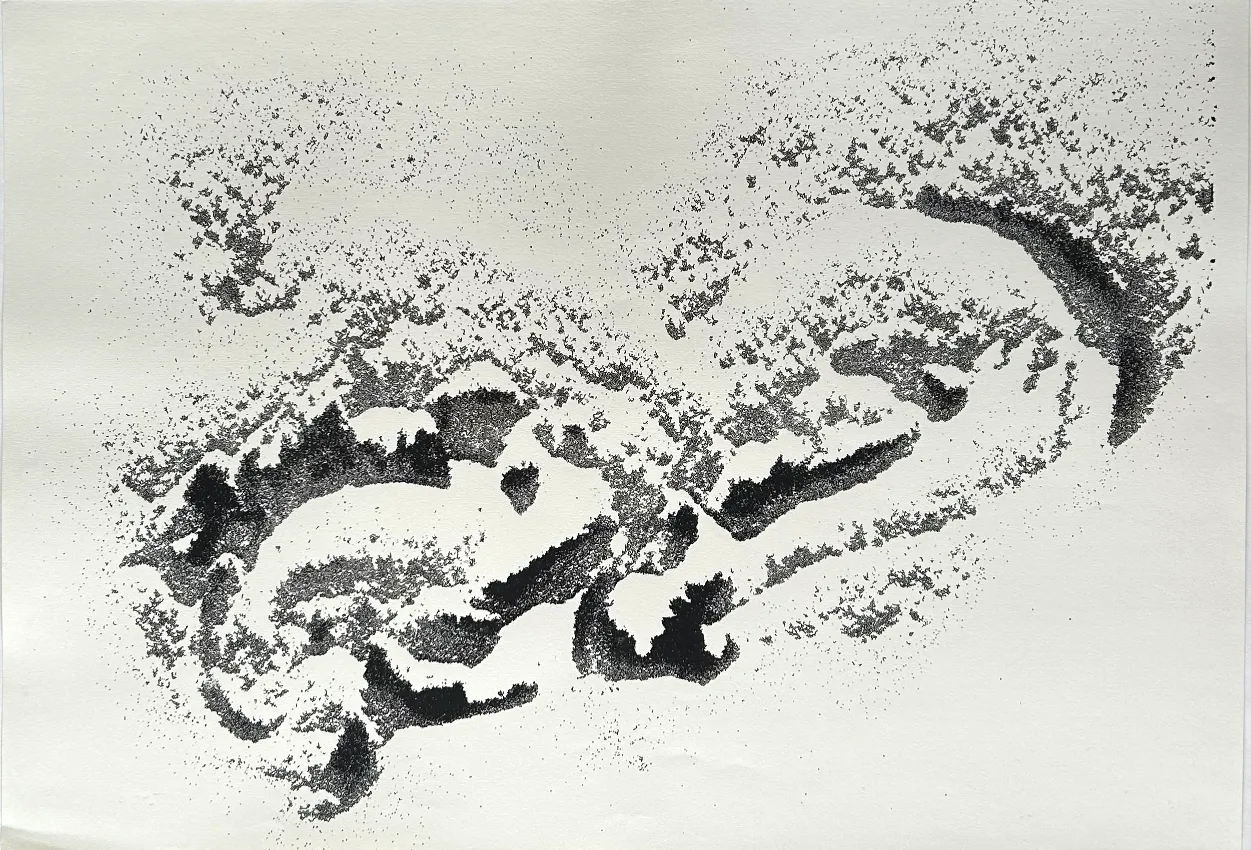
While his painting is carried predominantly in a coloristic spirit, his illustrations represent a distinctly linear-plastic approach; if painting does not tell a story, illustration describes richly. His initial inspiration was probably Josef Lada’s colored drawing, characterized by a strong contour line. Over time, Janáček transformed this type of illustration into a personal artistic signature, in which the lines flow freely yet with rhythmic certainty, creating a framework for an unmistakable mosaic of subtly shaded and playfully acting colors. His illustrations—representing the typically Czech blend of poetry and gentle humor—do not limit themselves to depicting the main characters of the story, but also portray larger or smaller parts of gently undulating landscapes with indispensable church towers or other landscape landmarks. In both graphics and painting, his most significant source of inspiration is nature. From it, Janáček draws not only the titles of his works but also the fundamental solutions to compositional problems. For him, the Earth is a stage of miracles and mysteries. His gaze is caught by inconspicuous yet significant details—a bud, a leaf, a small plant. Such details might be lost in everyday consciousness if not for the artist, who reveals what we might overlook in the rush of the day. The difference between the large and the small disappears, for a tiny bud represents the immense power of nature. Some of his prints, created using drypoint and aquatint, are small meditations on the matters of the macro- and microcosm.
Milan Janáček does not belong to those artists whose stylistic affiliation can be summed up in brief. As a landscape painter, he is predominantly imaginative, sometimes emblematic and expressive, and at other times even crosses over to the far shore where there is no trace of figurative art. Yet there exists an inner thread that connects all his works: the pursuit of color polyphony, the harmony of pictorial elements, and a heartfelt connection to his native land around South Bohemian Blatná, expressed through artistically refined landscape details. From his most personal experiences of nature, he has drawn the message for the viewer that we can truly know only what we love.